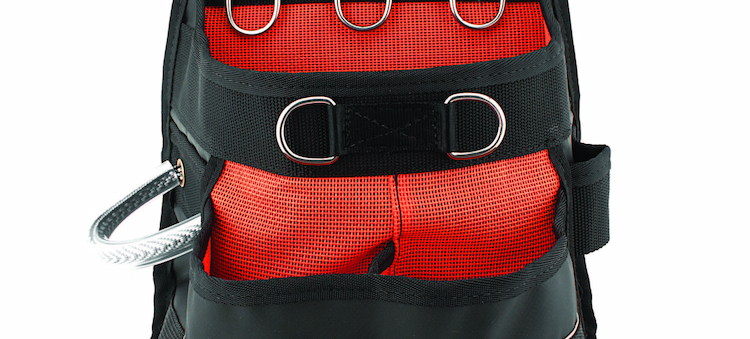
When working at height, dropped tools and equipment can create a serious hazard for people and property below. Keeping equipment contained and under control should therefore form part of the planning for work at height.
A suitable tool bag provides a practical way to transport and organise tools while keeping them readily accessible. However, the bag is only one part of a wider dropped-object prevention system. Tools may also need to be individually secured using appropriate tethering equipment, depending on the task and risk assessment.
For workers operating from scaffolding, MEWPs, towers, roofs and other elevated areas, choosing the right tool storage can help keep equipment organised and reduce the likelihood of loose items becoming a hazard.
A work-at-height tool bag is specifically designed for carrying tools in elevated working environments. Unlike a conventional tool bag, it incorporates features designed for the demands of working at height, such as reinforced construction, dedicated tethering points and a defined Working Load Limit (WLL).
The exact features will vary between designs and applications, so it is important to select a bag that is suitable for the tools being carried, the working environment and the manufacturer’s specified load limits.
Not all tool bags are designed for working at height. A professional work-at-height tool bag needs to do more than carry tools; it needs to withstand demanding site conditions while helping keep equipment secure and accessible.
At Leading Edge, our tool bags have been developed through ongoing field testing, customer feedback, and practical experience in height safety. Every aspect of the design, from the materials and stitching to the structural tethering points, has been considered with durability, performance, and safety in mind.
So, what should you look for when choosing a tool bag for working at height?
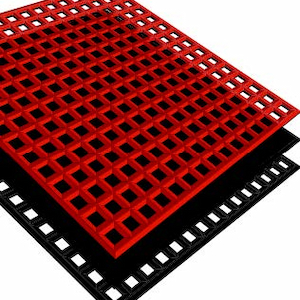
Every Leading Edge tool bag is constructed using multiple layers of structural mesh and high-grade PVC, with the number of layers varying according to the bag’s design and intended application.
The PVC provides a durable, UV-stabilised and mildew-resistant outer layer, while the structural mesh provides additional strength without unnecessarily increasing the weight of the bag. Combining these materials allows us to balance durability, flexibility and load-bearing performance.
The number and arrangement of layers are considered during the design process according to the demands placed on each bag. Higher-capacity designs incorporate additional reinforcement where required, helping the bag withstand the repeated loading and demanding conditions associated with professional use at height.
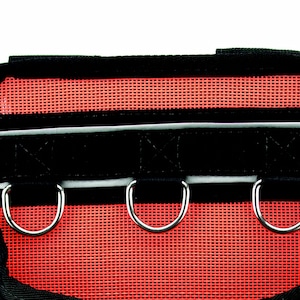
A tethering point is only as reliable as the structure supporting it. Rather than simply attaching a D-ring to the outside of a bag, Leading Edge integrates its tethering points into reinforced sections of the bag’s construction.
High-strength webbing is combined with internal reinforcement within the multi-layer fabric, helping distribute forces through a larger area of the bag rather than concentrating them around a single attachment point.
Our tethering points are repeatedly tested as part of the product development and quality-control process, with Leading Edge products tested to achieve a 47:1 safety factor. Each product has a specified Working Load Limit (WLL), which should always be checked before use and never exceeded.
Different applications also require different attachment configurations, which is why Leading Edge offers three different fixing-point options across its tethered tool bag range. We also offer three different fixing points!
Seams can create areas of concentrated stress and wear, particularly where different panels meet and loads are repeatedly applied. For this reason, reducing unnecessary seams is an important part of our bag design process.
Where the design allows, Leading Edge uses a single panel of material that is folded and formed into shape. This reduces the number of joins required and removes unnecessary stitching from areas that could otherwise experience additional stress.
By considering the construction of the bag as a whole, rather than simply adding reinforcement after manufacture, we can create designs that are better suited to the repeated demands of professional use.
The strength of a tool bag depends not only on the materials used, but also on how those materials are joined together.
Leading Edge uses multiple rows of stitching through the multi-layer fabrics and binding, with the number of rows varying according to the application. The stitching is carefully positioned and spaced to create strong, consistent joins while reducing the risk of the fabric pulling away from the edge under load.
Keeping the stitching within the specified distance from the edge also helps maintain consistent construction across the bag. These details may be easy to overlook, but they are an important part of designing equipment intended for repeated use in demanding working environments.
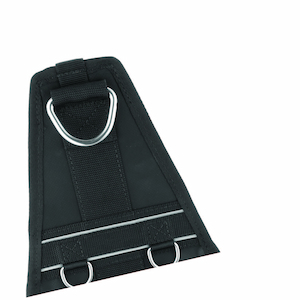
Traditional bag construction often relies on straight, right-angle joins where two panels meet. These areas can experience concentrated loading, particularly when the bag is carrying a heavy or uneven load.
Where appropriate, Leading Edge uses curved joins to help distribute forces over a larger area of the bag rather than concentrating them at a single corner.
This approach is particularly important around areas where the front, rear and base of the bag meet. By spreading the load and reducing sharp changes in direction, the construction is designed to withstand repeated loading and the demands of daily professional use.
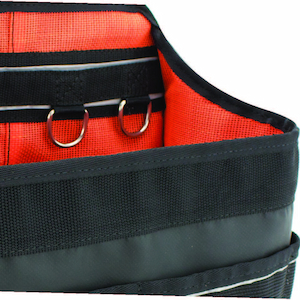
Areas exposed to concentrated or repeated loading require additional reinforcement. During the design process, Leading Edge identifies these potential load points and incorporates structural reinforcement where it is needed.
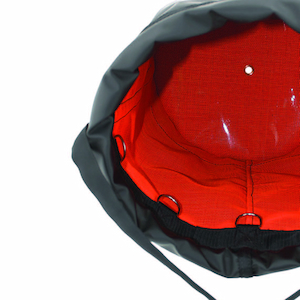
One example is the main opening of a tool bag. Structural webbing can be positioned around the circumference to help distribute the load through the bag rather than allowing stress to concentrate in one area.
Higher-capacity designs can incorporate a continuous rigid loop to provide additional structural support and help the bag maintain its shape under heavier loads.
This approach allows reinforcement to be integrated into the structure of the bag from the outset, rather than simply added as an afterthought.
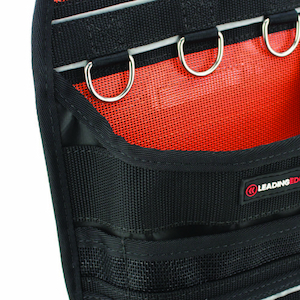
Edges are exposed to repeated contact, abrasion and handling during everyday use, making them an important consideration when designing a professional tool bag.
Leading Edge covers exposed edges with a tight-weave, coated binding material. This helps protect the underlying fabric from abrasion and reduces the likelihood of the edges becoming damaged through repeated handling.
The binding is integrated into the wider construction of the bag and secured using multiple rows of stitching, providing additional protection in areas that are likely to experience regular wear.
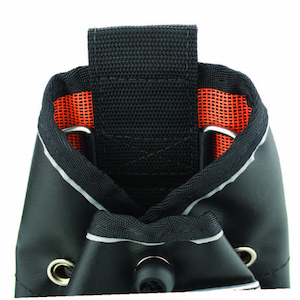
Every Leading Edge tool bag leaves our factory with product-specific identification, Working Load Limit information and technical documentation, providing traceability throughout its working life.
Traceability is particularly important for equipment used in professional working environments. It allows the product to be identified and its specifications checked against the manufacturer’s technical documentation throughout its service life.
Our labels are printed onto fibreless PVC and protected within a heat-shrink plastic pocket to help protect the information from abrasion, moisture and general site conditions.
The label provides important product and conformity information, which can be referenced alongside the relevant technical documentation. Always refer to the individual product documentation for the applicable standards, certification and Working Load Limit.
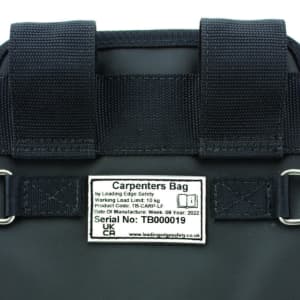
The working load limit (WLL) is one of the most important specifications to check when selecting a tool bag for work at height. The bag should be capable of safely carrying the tools and equipment required for the task without exceeding its stated capacity.
WLL varies between tool bags, so there is no single weight limit that applies to every design. For example, Leading Edge bags have different capacities depending on their size and intended application, with individual products carrying stated WLLs of up to 25kg.
Always check the manufacturer’s stated WLL before loading a bag and consider the combined weight of the tools, equipment, and any additional attachments being carried.
| Task | Suitable option |
| Carrying a small selection of hand tools | Small Engineer’s Bag |
| Carrying larger tool collections | Large Engineer’s Bag |
| Working from a MEWP | MEWP Bag |
| Carrying tools vertically | Tool Caddy / Aerial Bucket |
| Electrical/live-voltage applications | LV Tool Bags |
| Larger equipment loads | Big Pig Bucket |
| Aerial/telecom work | Aerial Rucksack |
| Debris management | Debris Catcher |
Our tool bags have evolved significantly since we began developing PPE specifically for work at height. From the outset, we focused on understanding the practical challenges faced by workers in the field and used customer feedback and real-world experience to guide our designs.
Each generation has been refined through product testing, customer feedback, and the lessons learned from how our bags perform in demanding working environments. This ongoing process has influenced everything from the materials and construction methods we use to the positioning of reinforcement and tethering points.
The bags we produce today are the result of years of practical experience, testing, and continuous design refinement. Rather than developing a product once and leaving it unchanged, we continue to review and improve our designs as working practices, customer requirements and our understanding of tool tethering develop.
 Leading Edge is a UK based height safety training provider and PPE manufacturer. From small teams to multinational blue-chips, we empower people to work safely at height across a wide range of industries.
